
Immigration wants your Japanese spouse’s koseki tohon, the passport office wants your child’s, and an inheritance needs a whole stack of registers. This guide explains what a koseki tohon shows, who may request one, the fastest route for your situation and how recent each office wants it.
At a glance
- Only Japanese nationals have a koseki. A foreign spouse is named in the Japanese spouse’s marriage entry and can request that register with a residence card.
- Since 1 March 2024 any city or ward office in Japan issues a koseki tohon for ¥450, but only in person, to you, your spouse or a direct relative such as a parent or child: no proxies, no mail.
- Convenience stores print it with a My Number Card for ¥300 to ¥450 in the cities we checked, but only from your own register.
- It has no expiry date, but passport offices want one issued within 6 months and Immigration within 3 months.
- No office issues it in English. Translate it yourself or use a translator, after checking what the receiving office accepts.
What is a koseki tohon?
A koseki tohon is the certified full copy of a family register (戸籍, koseki), the record Japan keeps of a Japanese national’s birth, parents, marriage, divorce, adoption and death. It lists everyone in that register, comes from a city, town or village office, and is how Japanese nationals prove their family relationships and their citizenship.
The meaning of koseki tohon comes straight from the words: koseki is the register, and tōhon (謄本) is a certified copy of all of it. You will rarely see 謄本 on the paper itself. Registers kept on computer are issued as a family register certificate headed 全部事項証明 (certificate of all recorded matters), which the Family Register Act (戸籍法) treats as a tohon, so offices and forms use both names.
Each register belongs to a registered domicile (本籍, honseki): an address in Japan chosen by the family, which can be in a different city from where anyone lives. Until 2024 only that municipality could issue the certificate. Since 1 March 2024 any city office can issue it to you in person, but postal requests, some older registers and a few related certificates still go to the honseki office.
The current Act dates from 1947. Entries come from notifications people file at a city office: a birth within 14 days, a death within 7 days of learning of it. Foreign residents must also report births and deaths that happen in Japan, as Shinjuku City’s English guide notes, even though they never get a register of their own.
Koseki tohon family register: one couple, their children, no foreign members
A register is opened for one married couple and their children who share the couple’s surname. It is named after its honseki and the person listed first, the head of the register (筆頭者, hittōsha): the spouse whose surname the couple uses.
Marriage opens a new register for the couple unless the spouse whose surname they keep already heads one, so children usually leave their parents’ register when they marry. An adult who is neither the head nor the head’s spouse can also leave by splitting off (分籍, bunseki).
Foreign nationals never get a register or an entry of their own. Registers exist only for Japanese citizens, which is why, as the US Embassy’s summary puts it, a koseki also certifies citizenship. Permanent residence does not change this; naturalisation does, because a new Japanese citizen is entered in a register.
When a Japanese national marries a foreign national, no register is created for the foreign spouse. The marriage is written into the Japanese spouse’s register with the foreign spouse’s name, date of birth and nationality, as Chuo City explains. If the Japanese spouse was still in their parents’ register, a new register is opened for them, and their children with the same surname are entered in it. The Japanese spouse keeps their surname unless they file to take the foreign spouse’s within 6 months of the marriage. So when an office asks a foreign wife or husband for a koseki tohon, it means the Japanese spouse’s.
Foreign residents appear instead on the resident record their city keeps. Our guide to the juminhyo (certificate of residence) explains that document.
Koseki tohon vs koseki shohon: ask for the tohon unless told otherwise
A koseki shohon (戸籍抄本, koseki shōhon), now issued as a 個人事項証明 (certificate of individual matters), covers only the people you name in the register. Both cost ¥450 a copy under the national fee standard, so cost never decides which one you get.
Choose the tohon unless the receiving office asks for a shohon. Passport offices have accepted only the tohon since 27 March 2023, the spouse visa application asks for the Japanese spouse’s tohon, and nationwide issuance (広域交付, kōiki kōfu), which lets any city office issue it, gives only the tohon.
| Document | In Japanese | What it shows | Fee (national standard) | Where to get it |
|---|---|---|---|---|
| Full copy (koseki tohon) | 戸籍謄本, issued as 戸籍全部事項証明書 | Everyone in the current register | ¥450 | Any city office in person, honseki office, convenience store, by mail, online in some cities |
| Extract (koseki shohon) | 戸籍抄本, issued as 戸籍個人事項証明書 | Only the people you name | ¥450 | Honseki office, convenience store, by mail; not by nationwide issuance |
| Closed register (joseki tōhon) | 除籍謄本 | A register everyone has left, for example after deaths and marriages; kept for 150 years | ¥750 | Honseki office in person or by mail, or any city office in person; not at convenience stores |
| Pre-revision register (kaisei genkoseki) | 改製原戸籍 | The original register from before it was rewritten after a change in format or rules | ¥750 | As for a closed register; some old ones only at the honseki office |
| Marriage acceptance certificate | 婚姻届受理証明書 | That a marriage notification was accepted | ¥350, or ¥1,400 on formal certificate paper | The office that accepted the notification |
Who can request a koseki tohon, including a foreign spouse
Article 10 of the Family Register Act gives the right to request a koseki tohon to anyone recorded in the register, including people who have since left it; to their spouse; to their lineal ascendants, such as parents and grandparents; and to their lineal descendants, such as children and grandchildren.
So can a foreigner get a koseki tohon? Not one of their own, but the article says spouse, not Japanese spouse, so a foreign wife or husband can request their Japanese spouse’s register in their own name. The Ministry of Justice’s rule on proof of identity lists the residence card (在留カード, zairyū kādo) and the special permanent resident certificate alongside the passport, driving licence and My Number Card. Chuo City and Suginami City list the residence card as accepted photo ID for nationwide issuance.
Everyone else needs a reason or your permission. Brothers and sisters are not lineal relatives, so one who has left the register is a third party. Third parties must state why they need it, such as to exercise a right or to submit it to a public office. Lawyers, judicial scriveners (司法書士) and administrative scriveners (行政書士) can request one for work they have been hired to do. A proxy acting for you, such as a friend, needs a letter of authorisation (委任状, ininjō) signed by you or another entitled person, plus their own photo ID. Obtaining a certificate by deception carries a fine of up to ¥300,000.
Asking for a register you are not in, such as a grandparent’s? If the office cannot see the link from the registers it holds, bring a copy of one that shows it, such as your parent’s koseki tohon naming that grandparent.
How to get a koseki tohon in Japan: in person is fastest since 2024
There are four ways to get one. Counter fees below follow the national fee standard; convenience store fees vary by city.
| Route | Who can use it | What you need | Fee | How fast |
|---|---|---|---|---|
| Any city or ward office, in person | You, your spouse, parents, grandparents, children, grandchildren. Proxies and shohon: honseki office only | Photo ID; a proxy also brings your 委任状 | ¥450; ¥750 for closed or older registers | Same day for a current register in Meguro; 5 business days for a booked birth-to-death set |
| Convenience store | My Number Card holders, for their own current register only | Card and 4-digit PIN; pre-registration if your honseki is in another city | ¥300 to ¥450, by city | On the spot, within the city’s hours; pre-registration takes 2 to 5 business days |
| By mail | Anyone entitled, or a proxy with your 委任状, writing to the honseki office | Request form, copy of ID, postal money order, stamped return envelope | ¥450, plus ¥200 per money order and ¥110 return postage | About 2 weeks in Yokohama |
| Online, some cities | People whose honseki is in that city and who live in Japan; posted only to their registered address | My Number Card, compatible smartphone, card payment | ¥450 plus postage | About 7 business days to dispatch in Meguro |
At any city or ward office (nationwide issuance)
Any city or ward office in Japan can issue your koseki tohon, wherever your honseki is, but nationwide issuance has firm limits:
- Only you, your spouse, parents, grandparents, children or grandchildren, in person. Nobody can go for you, with a letter of authorisation or as a legal guardian, and there is no postal option.
- Photo ID issued by a public body, such as a My Number Card, driving licence, passport or residence card. Health insurance and pension documents are not accepted, so without photo ID you cannot use it.
- Full copies only: the tohon and closed or pre-revision registers. No shohon or partial certificate, and none of the few old registers that were never put on computer. The address history (戸籍の附票, koseki no fuhyō) and certificates such as the single-status certificate (独身証明書) still come only from the honseki office.
- Time and hours vary. Meguro City issues a current register the same day as a rule, but a birth-to-death set for an inheritance must be booked online and takes 5 business days for one person or 7 for two, after a counter visit of up to 2 hours. Yokohama handles these requests only at ward office family register sections, on weekdays from 8:45 to 17:00.
At your honseki office the ordinary rules apply: a proxy can go for you with your 委任状, and you can ask for a shohon or the address history.
The documents required for a koseki tohon at the counter are the request form, your photo ID and, for a proxy, the 委任状.
- Go to the family register section (戸籍課 or 戸籍係) of the city or ward office. Some offices post their request form online, so you can fill it in at home.
- Fill in the form. The boxes are explained below.
- Show your photo ID, and hand over the 委任状 if you are a proxy.
- Pay the fee and collect the certificate. If the office has to check with your honseki office, you may have to come back another day.
Ask whether the office has an interpreter: some wards offer free video interpretation on a tablet at the counter. Minato City’s covers English and 12 other languages, needs no booking and runs during office hours, 8:30 to 17:15.
Each city designs its own koseki tohon application form (request form). These are the boxes on Yokohama’s 戸籍証明等請求書 and what to write:
| Box | In Japanese | What to write |
|---|---|---|
| Registered domicile | 本籍 | The full honseki address. If your Japanese family member is unsure, their juminhyo can include it if they ask for it. |
| Head of the register | 筆頭者氏名 | The person listed first in the register (戸籍のはじめに書かれている人), and their date of birth |
| What you need | 何が必要ですか | Tick 戸籍全部事項証明(謄本) for a tohon, 戸籍個人事項証明(抄本) for a shohon or 除籍(原戸籍) for closed and older registers, and write the number of copies (通数) |
| Whose shohon | 必要な方の名前 | For a shohon only: the names of the people it should cover |
| Applicant | 請求者(住所・氏名・電話) | Your address, full name with its reading, and phone number |
| Your relationship | 請求者本人は | この戸籍に名前のある人 if you are in the register; 夫・妻・子・孫・父・母・祖父・祖母 (husband, wife, child, grandchild, father, mother, grandfather, grandmother) of someone in it; その他の人 (anyone else), with your reason |
| Special requests | 必要としている戸籍 | For an inheritance, tick 出生から死亡までの (from birth to death) and name the person who died |
At a convenience store
If your honseki city takes part, the multi-copy machine (マルチコピー機) at Seven-Eleven and other participating convenience stores (konbini) prints a koseki tohon with your My Number Card and its 4-digit PIN; three wrong entries lock it. Check your honseki on J-LIS’s list of participating municipalities: it needs a ○ in the 戸籍 row, or the 戸籍(本籍地) row if you live elsewhere.
Two limits matter. It prints only the card holder’s own register, so a foreign spouse, who has no register, cannot print the Japanese spouse’s. And it prints only the current register: no closed or pre-revision registers.
If your honseki is in a different city from where you live, pre-register with the honseki city first. This pre-registration (利用登録申請, riyō tōroku shinsei) needs the physical card rather than a phone, is free in Setagaya and takes 2 to 5 business days depending on the city. Repeat it after renewing your card or its certificate. Setagaya also accepts it from people who have moved abroad, for use when they are back in Japan.
- At the multi-copy machine, choose the administrative service menu (行政サービス) and the registration application for koseki certificates.
- Choose your honseki prefecture and municipality, then enter the rest of the honseki address and the name of the head of the register.
- Enter your phone number, date of birth, and your card’s expiry date and security code.
- Place your card on the reader, enter your 4-digit PIN, confirm, and keep the 16-digit application number.
- Check J-LIS’s registration status page until it shows 利用登録完了 (registration complete). The city does not contact you.
- To print, choose certificate issuance, place your card, and select お住まいの市区町村と本籍地が異なる方の戸籍関連証明書 (koseki certificates for people whose honseki is elsewhere).
- Enter your PIN, choose your honseki and 全部事項証明 for a tohon, enter the number of copies, pay at the machine and take the certificate and receipt.
| City | Fee per copy | Koseki hours | Pre-registration |
|---|---|---|---|
| Yokohama | ¥450 | 9:00 to 17:00, weekends included, not public holidays | Up to 5 business days (its FAQ says 2 to 3) |
| Setagaya, Tokyo | ¥350 | Monday to Saturday, 9:00 to 17:00, except the third Saturday | About 5 days |
| Hamamatsu | ¥300 (¥450 at the counter) | 7:00 to 21:00 | 3 to 5 business days |
Koseki hours can be shorter than for other certificates. In Hamamatsu, a juminhyo prints from 6:30 to 23:00 but a koseki only from 7:00 to 21:00, so check your honseki city’s page.
By mail from your honseki office
The Family Register Act lets anyone entitled request the certificate by post, but only from the honseki office: Shinjuku City states that certificates from nationwide issuance cannot be requested by mail. Using Shinjuku’s list, a postal request contains:
- The request form from the honseki city’s website, or a letter with the same details.
- A copy of photo ID showing your name and current address, such as a driving licence or the front of your My Number Card.
- A postal money order (定額小為替, teigaku kogawase) for the exact fee, bought at a post office for ¥200 per order, issued within the last 6 months, with the payee left blank. Some cities, Shinjuku among them, also take cashless payment.
- A return envelope addressed to your registered address, with a stamp: ¥110 covers a standard letter up to 50 g.
- If you are not in the register you want, a copy of a register that shows your relationship.
Allow time. Yokohama’s postal request centre says about 2 weeks from posting to delivery; its older request form says 7 to 10 days.
Online, in some cities
Some honseki cities take requests online with your My Number Card and post the certificate. Meguro City has done so since 1 February 2025 for people whose honseki is in Meguro and who are registered as living in Japan: ¥450 a copy plus postage from ¥110, paid by credit card or PayPay, dispatched in about 7 business days. Sapporo charges ¥450 a copy plus ¥110 postage per request. Both post only to your registered address and do not issue closed or pre-revision registers online. Search your honseki city’s site for オンライン申請 and 戸籍.
Getting a koseki tohon from abroad: post a request and pay in cash yen
Nationwide issuance and convenience stores need you at a counter or machine in Japan. Japanese nationals abroad, and descendants tracing family, request the koseki tohon by post from the honseki office or ask someone in Japan to. Yokohama’s rules for overseas requests show what to expect:
- Use the city’s overseas request form and give an email address, since phone calls across time zones are hard.
- Enclose a copy of ID showing your overseas address, such as a driving licence, lease or utility bill. A passport shows no address, so it is not enough.
- Pay in cash Japanese yen, sent by registered or insured international mail where your post office allows it, or have someone in Japan send the fee by registered cash mail (現金書留) or postal money order. Bank transfers and international reply coupons are refused, and international postal money orders stopped being issued on 27 March 2020.
- The certificate goes back only to the address on your ID. For EMS, say so on the form and send the EMS postage plus ¥51 for the envelope.
Rules differ by city: Shinjuku, for example, also takes cashless payment for postal requests. Read your honseki city’s overseas request page before you post anything.
Someone in Japan can also request it for you with a 委任状 you sign. Your spouse, a parent, a child or anyone in the same register needs no 委任状. A parent or child in Japan can even get it the same day at their nearest city office under nationwide issuance, as a request in their own right.
How recent your koseki tohon must be depends on who asked for it
The Family Register Act sets no validity period for a koseki tohon. The office that receives it does, and it may also need specific entries:
| Purpose | What to submit | Issued within |
|---|---|---|
| Japanese passport, including your child’s | The original koseki tohon with up-to-date entries; shohon have not been accepted since 27 March 2023 (Shiga, Osaka) | 6 months |
| Japanese passport through My Number Portal (マイナポータル) | An electronic certificate code (戸籍電子証明書提供用識別符号) instead of paper: a password valid for 3 months; ¥400 at a city counter | Within the code’s 3-month validity |
| Spouse visa (日本人の配偶者等): certificate of eligibility, change or extension | The Japanese spouse’s koseki tohon showing the marriage; for a new application or change, add the marriage acceptance certificate if the marriage is not yet recorded (Immigration Services Agency) | 3 months |
| Inheritance and registering inherited property | The deceased’s registers from birth to death | Ask the bank or the Legal Affairs Bureau |
| Bank, employer or foreign embassy | Ask them which copy they need | Ask them |
Inheritance needs the most paperwork. Since 1 April 2024, heirs must register inherited land or buildings within 3 years of learning they inherited them, or risk an administrative fine of up to ¥100,000; property inherited before then must be registered by 31 March 2027. Rather than handing the full stack of registers to every bank and registry, file it once at a Legal Affairs Bureau (法務局) under the statutory heirs information system (法定相続情報証明制度), and receive certified copies of the family chart free of charge.
Request it shortly before you need it, and order one copy for each office in a single request.
Koseki tohon sample: what each line means
Registers kept on computer are printed in the A4 format set by the Family Register Rules (戸籍法施行規則), so computerised koseki tohon all look alike; older closed and pre-revision registers use earlier formats. This is the Ministry of Justice’s own model certificate, with fictional names, in the current layout that includes name readings. Page 1 is shown, then the certification from the end of the last page.
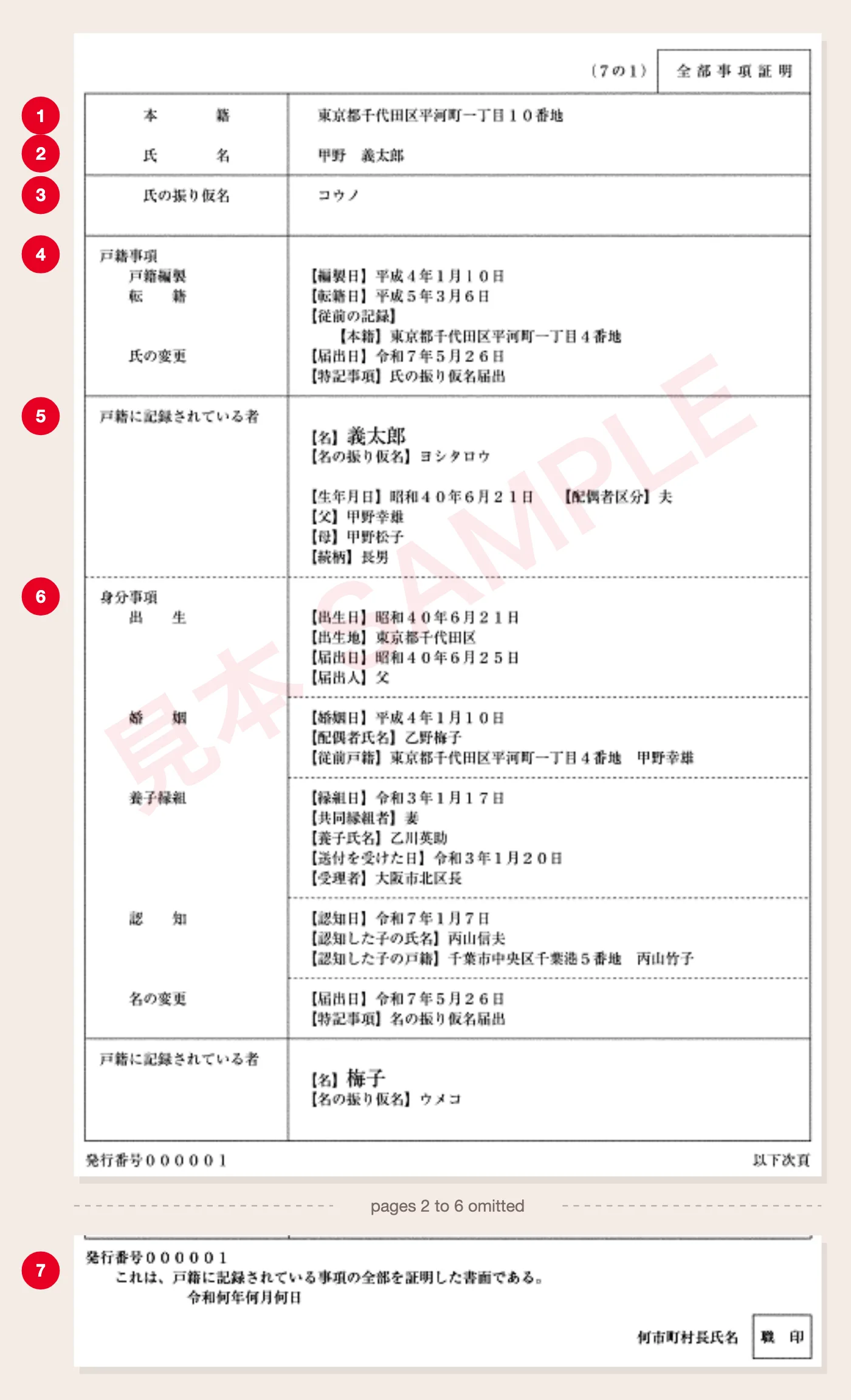
| Item | In Japanese | What it tells you |
|---|---|---|
| 1. Registered domicile | 本籍 | The honseki address, and so the office that keeps the register |
| 2. Head of the register | 氏名 | The surname and given name of the person listed first |
| 3. Surname reading | 氏の振り仮名 | The surname in katakana, recorded since 2025 |
| 4. Register events | 戸籍事項 | When the register was opened (戸籍編製) or moved to another honseki (転籍), and changes to the whole register |
| 5. Person in the register | 戸籍に記録されている者 | One block per person: given name and its reading (名の振り仮名), date of birth, father (父), mother (母), relationship to them (続柄) such as 長男 (eldest son), and 配偶者区分: 夫 (husband) or 妻 (wife) |
| 6. Personal events | 身分事項 | One entry per event, with dates: 出生 (birth: date, place, who reported it), 婚姻 (marriage: date, spouse’s name, previous register), 養子縁組 (adoption), 認知 (acknowledgement of paternity), 名の変更 (change of given name). For a foreign spouse, the marriage entry gives their name, nationality and date of birth. |
| 7. Certification | 発行番号・認証文 | The certificate number and the line これは、戸籍に記録されている事項の全部を証明した書面である (this certifies all matters recorded in the register), with the date and the mayor’s name and seal |
Dates follow the Japanese era: add 1925 to a Shōwa (昭和) year, 1988 to a Heisei (平成) year and 2018 to a Reiwa (令和) year, so 昭和40年 is 1965 and 令和7年 is 2025. Pages are numbered like (7の1), page 1 of 7, and the certificate ends with 以下余白 (nothing follows).
Name readings are new. A 2023 amendment added them from 26 May 2025, and cities posted each person the reading they planned to record. Where nobody filed a different reading by 25 May 2026, the notified reading is entered from 26 May 2026 onwards, and it can be changed once without a family court’s permission. People living abroad could not be sent the notice.
Koseki tohon in English: no office issues one, so you translate it
City offices issue the koseki tohon only in Japanese. Kawasaki City’s answer is typical: its ward offices cannot issue certificates such as the koseki tohon in a foreign language, so translate it yourself or use a translation company, and ask a Japanese embassy or consulate if an official translation is required.
Whose translation is accepted depends on who receives it. The US Embassy in Tokyo, for example, publishes a fill-in translation template for the koseki tohon, for US passport applications and reports of birth abroad. Before paying for a translation, ask the receiving office whether yours is enough or whether it needs a translator’s certificate, notarisation or an apostille.
Yuki’s Angels’ bilingual assistants can translate and explain your koseki tohon line by line, so you know what it says before it goes to an office.
Koseki tohon FAQ
Is a koseki tohon a birth certificate?
Not as such, but it serves as one for a Japanese national: the birth is an entry in the register, with the date, the place and who reported it. The US Embassy, for example, accepts translations of it for US passports and reports of birth abroad. For a child who is not a Japanese national, ask the city that accepted the birth notification for a certificate of acceptance (出生届受理証明書), ¥350 under the national fee standard.
What is the English translation of “koseki tohon”?
There is no official one. “Certified copy of the family register” is the usual translation, and the US Embassy’s translation template is headed “Translation of Family Register Certificate”, with “Complete Record of Family Register” for the full copy.
What is the Japanese for “marriage certificate”?
For a marriage registered in Japan, the spouses can ask the office that accepted it for a 婚姻届受理証明書 (kon’in todoke juri shōmeisho): ¥350, or ¥1,400 on formal certificate paper, under the national fee standard. If one spouse is Japanese, their koseki tohon also shows the marriage once it is entered.
Does a koseki tohon show my address?
No. It records the honseki, not where anyone lives. Addresses are in the address history (戸籍の附票), which the honseki office issues, or on each person’s juminhyo.
How we can help
Your assistant can check which copy the receiving office wants, fill in the request form in Japanese, call the honseki office to confirm its fees and payment rules, prepare a postal request with the right money order, and translate and explain the certificate when it arrives.
Requirements vary between offices and change over time. Fees, hours and rules above were checked against official pages on 23 October 2026. Check with your city or honseki office before you go.
Sources
- Family Register Act, Articles 6, 9, 10, 10-2, 10-3, 12, 13, 14, 16, 18, 21, 48, 49, 86, 120, 120-2 and 135 (e-Gov, Japanese)
- Family Register Rules, Articles 5 and 11-2, and Appended Form 24 (model certificate) (e-Gov, Japanese)
- Cabinet Order on standard fees for local governments: family register fees (e-Gov, Japanese)
- Basic Resident Registration Act, Article 7 (e-Gov, Japanese)
- Copyright Act, Article 13 (e-Gov, Japanese)
- Cabinet orders changing the era name to Heisei and Reiwa (e-Gov, Japanese)
- Amended Family Register Act from 1 March 2024: nationwide issuance and electronic certificates (Ministry of Justice, Japanese)
- Name readings in the family register and how they were recorded (Ministry of Justice, Japanese)
- Mandatory registration of inherited property (Ministry of Justice, Japanese)
- Statutory heirs information system (Legal Affairs Bureau, Japanese)
- Spouse of a Japanese national: required documents (Immigration Services Agency, Japanese)
- First passport applications (Shiga Prefecture, Japanese) and koseki tohon for passport applications (Osaka Prefecture, Japanese)
- Getting a koseki certificate from your honseki at a convenience store and participating municipalities (J-LIS, Japanese)
- Nationwide issuance, requests at the counter, closed and pre-revision registers, convenience stores for residents of other cities, convenience store FAQ, postal requests, requests from overseas and its request form (Yokohama City, Japanese)
- Nationwide issuance and online requests (Meguro City, Japanese)
- Online requests for koseki certificates (Sapporo City, Japanese)
- Koseki certificates at convenience stores (Setagaya City, Japanese)
- Convenience store koseki for people living outside the city (Hamamatsu City, PDF, Japanese)
- Convenience store koseki for people living outside the city (Funabashi City, Japanese)
- Postal requests for koseki certificates (Shinjuku City, Japanese) and Family Register (Koseki) (Shinjuku City)
- Notifications involving foreign nationals and nationwide issuance (Chuo City, Japanese)
- Nationwide issuance (Suginami City, Japanese)
- Certificates in foreign languages (Kawasaki City FAQ, Japanese)
- Video interpretation on a tablet at ward office counters (Minato City, Japanese)
- Postal money orders and their fee (Japan Post Bank, Japanese)
- Domestic letter rates (Japan Post, Japanese)
- Japan’s Family Registry System and translation templates, including the koseki tohon template (US Embassy & Consulates in Japan)