
Banks, landlords, employers and the immigration office all ask for one, and the copy they want is often not the one you get by default. This guide shows a labelled juminhyo sample, translates the application form box by box and lists what to tick for each purpose.
At a glance
- It comes from the city, ward, town or village office where you are registered, not from Immigration.
- Fastest route: a convenience store kiosk with your My Number Card, usually open 6:30 to 23:00.
- A standard copy leaves out your nationality, status of residence and My Number. Tick them on the form if you need them.
- Immigration asks for copies issued within the last 3 months. Tokyo’s licence centres accept 6 months.
What is a juminhyo (jūminhyō)?
A juminhyo (住民票, jūminhyō) is the resident record your municipal office keeps for everyone registered at an address in Japan, Japanese or foreign. When someone asks for “your juminhyo”, they mean a certified copy of it (住民票の写し), which proves your name, address and household and, for foreign residents, nationality and status of residence.
Foreign residents have been part of the same system since 9 July 2012. You have a record if you live in Japan legally for more than three months: residence card holders, special permanent residents, people granted temporary refuge or provisional stay, and children born in Japan or people who lost Japanese nationality during their transitional stay. Tourists and other temporary visitors, people allowed to stay three months or less, and Diplomat or Official status holders do not.
Getting a jūminhyō starts with registering your address. Within 14 days of moving in, file a moving-in notice at your new office: the Basic Resident Registration Act sets a fine of up to ¥50,000 for not doing so without good reason. Our 14-day address checklist walks through that visit.
Addresses from before 9 July 2012 are not on a juminhyo. If you need them, request your old alien registration records from the Immigration Services Agency.
How to get a juminhyo in Japan
There are three standard ways to get a copy, plus online requests in some cities. Each municipality sets its own fees, so the figures below are Shinjuku City’s, as an example.
| Method | What you need | Fee (Shinjuku) | How fast |
|---|---|---|---|
| City or ward office counter | Request form and photo ID | ¥300 per copy | Usually the same visit |
| Convenience store kiosk | My Number Card and 4-digit PIN, or a phone with the card added | ¥200 per copy | A few minutes |
| By mail | Request, copy of ID, postal money order, return envelope | ¥300 per copy, plus ¥200 money order charge and ¥110 return postage | Several days or more |
| Online (some cities) | My Number Card with signature certificate, compatible smartphone | ¥300 per copy plus ¥110 postage | Posted after review |
Other cities charge differently: Aizuwakamatsu charges ¥200 at the counter, for example. Check your own city’s page before you go.
At your city or ward office
Getting a juminhyo at the city office works for everyone, including new arrivals who do not have a My Number Card yet.
- Find the resident records counter at your city or ward office. Many offices post the request form (住民票の写し等交付請求書) on their website, so you can fill it in at home.
- Fill in the form. The box-by-box guide below shows what to write.
- Show photo ID: residence card, My Number Card, passport or driving licence.
- Pay the fee and collect your copy.
Someone else can collect it for you. Members of your household can apply directly. Anyone else needs a power of attorney (委任状) signed by you, plus their own photo ID.
At a convenience store (7-Eleven, Lawson, FamilyMart)
If your municipality takes part, you can print a juminhyo on the multi-copy machine at Seven-Eleven, Lawson, FamilyMart, Ministop and other participating stores, usually from 6:30 to 23:00, except over New Year and on maintenance days.
- On the multi-copy machine, tap 行政サービス (government services), agree to the terms and choose 証明書交付サービス (certificate issuance).
- Place your My Number Card on the reader and choose the municipality where you are registered.
- Enter your 4-digit PIN, then take your card back.
- Select 住民票の写し (copy of resident record), whose record you need and which optional items to include.
- Enter the number of copies, check the summary, pay at the machine and collect your copy.
Phones work too. Since 24 June 2025 you can add your My Number Card to an iPhone and use it at participating stores with Face ID instead of the PIN. Android phones with the smartphone certificate also work. The old Juki card stopped working at kiosks on 24 December 2025. Forgot your PIN? If you still know your 6 to 16 character signature password, you can reset it at some convenience store kiosks; otherwise, go to your city office.
By mail
The law lets you request a juminhyo by mail, which helps if you are away or need a record from a previous city. Check your city’s page for its form and address, then send:
- The request form, or a signed letter with your name, address, date of birth, phone number, whose record you need, which items, how many copies and what it is for.
- A photocopy of your ID showing your name and current address. For a residence card, copy the back too if your new address is written there.
- A postal money order (定額小為替) for the exact fee, from any post office. Japan Post Bank charges ¥200 per order.
- A return envelope addressed to yourself, with a stamp. ¥110 covers a standard-size letter up to 50 g.
Online, in some cities
Some cities, including Shinjuku, Chiba and Sapporo, take requests online. You sign with your My Number Card’s signature certificate on a compatible smartphone, pay online and receive the copy by post at your registered address. It is not instant: Shinjuku suggests a convenience store if you are in a hurry.
Juminhyo sample: what each line means
Municipalities have been moving their systems to a national standard, with a target of March 2026 (later for some), so copies increasingly look the same everywhere: an A4 sheet headed 住民票, with a box for each item. This is the Ministry of Internal Affairs and Communications’ own example for a foreign resident, with every optional item included, so you can see what information is on a juminhyo and where.
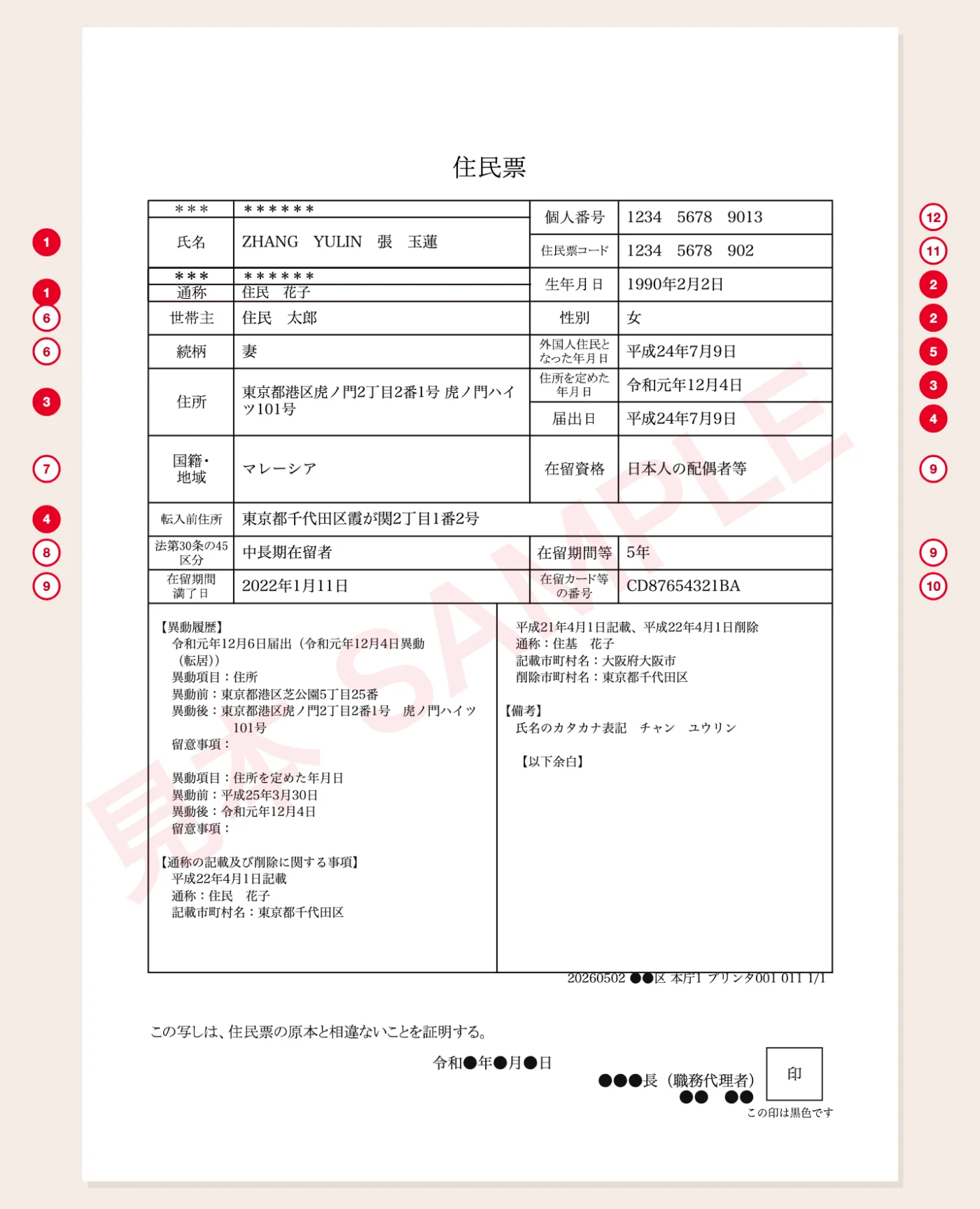
| Item | In Japanese | On a standard copy? |
|---|---|---|
| 1. Name, and registered alias if any | 氏名・通称 | On every copy |
| 2. Date of birth and sex | 生年月日・性別 | On every copy |
| 3. Address and the date you moved in | 住所・住所を定めた年月日 | On every copy |
| 4. Notification date and previous address | 届出日・転入前住所 | On most copies |
| 5. Date you became a foreign resident | 外国人住民となった年月日 | On every copy |
| 6. Householder and your relationship to them | 世帯主・続柄 | Only if you ask |
| 7. Nationality or region | 国籍・地域 | Only if you ask |
| 8. Resident category, such as mid-to-long-term resident | 法第30条の45区分 | Only if you ask |
| 9. Status of residence, period of stay and expiry date | 在留資格・在留期間等・在留期間満了日 | Only if you ask |
| 10. Residence card number | 在留カード等の番号 | Only if you ask |
| 11. Resident record code | 住民票コード | Only if you ask |
| 12. My Number | 個人番号 | Only if you ask |
Your date of birth and the expiry date of your period of stay are written in the Western calendar; every other date uses the Japanese era, such as 平成 or 令和. The large box at the bottom (統合記載欄) records changes, such as an earlier address or alias, and remarks such as the katakana reading of your name.
Japanese nationals’ copies can also show their registered domicile (本籍), and from 26 May 2025 a reading of the name in katakana is being added. Foreign residents’ copies show nationality instead, with no name reading.
The resident record code (住民票コード), often called the juminhyo code, is a random 11-digit number that government offices use to confirm your identity across the national network. You can ask your city to change it at any time, and private companies are not allowed to ask you for it.
An official copy carries the mayor’s certification and the office seal. A photocopy of it is not an official copy, which is why offices such as Tokyo’s licence centres ask for the original.
The juminhyo application form, box by box
Each municipality designs its own request form, but they all ask the same questions. Here is what each box means and what to write.
| Box | In Japanese | What to write |
|---|---|---|
| Applicant | 請求者・窓口に来た方 | Your name, address, date of birth and phone number. Collecting for someone else? Your details go here. |
| Whose record | 必要な方 | The person whose record you need, usually you. |
| Document | 住民票の写し・記載事項証明書・除票 | A full copy, a certificate of selected items, or the record of someone who has moved away. |
| Range | 世帯全員・世帯の一部・本人のみ | Whole household, some members (list their names), or just you. |
| Optional items | 世帯主・続柄、本籍・筆頭者、個人番号、住民票コード、国籍・地域、在留資格等 | Tick only what the receiving office asks for. See the next section. |
| Copies | 通数 | How many. Get two if more than one procedure is coming up. |
| Purpose | 使いみち・提出先 | Where it is going, for example 銀行 (bank), 勤務先 (employer), 入管 (immigration) or 運転免許 (driving licence). |
| Relationship | 対象者との関係 | 本人 (self), 同一世帯 (same household) or 代理人 (proxy, with a 委任状). |
Tip
Not sure what to tick? Ask the office that wants the document. If they say “everything except My Number”, tick every optional item except 個人番号.
Which juminhyo to ask for, and how recent it must be
A juminhyo has no expiry date, but whoever receives it decides how recent it must be and which items it needs. Two official examples, and what to do for everything else:
| Purpose | What to request | How recent |
|---|---|---|
| Permanent residence application (Immigration Services Agency) | Whole household, every item except My Number | Issued within 3 months |
| Converting a foreign driving licence in Tokyo (Metropolitan Police) | Nationality, status of residence, period of stay, expiry date and residence card number; no My Number; the original | Issued within 6 months |
| Other immigration applications | Follow the document list for your status | Usually within 3 months |
| Bank account, rental contract, employer | Ask which items they need | Ask them |
Get it shortly before you need it, and if several procedures are coming up, request all the copies in one go.
Certificate of residence: juminhyo or another document?
What is a certificate of residence? In Japan the term covers several different documents, so check which one is meant before you apply.
| Document | Issued by | What it proves | Who can get it |
|---|---|---|---|
| Juminhyo copy (住民票の写し) | City or ward office | Address and household; nationality and status if requested | Anyone registered in Japan |
| Certificate of registered items (住民票記載事項証明書) | City or ward office | Only the items you choose | Anyone registered in Japan |
| Residence card (在留カード) | Immigration Services Agency | Status of residence, period of stay, address | Mid-to-long-term foreign residents |
| Family register (戸籍謄本, koseki tōhon) | Office of the registered domicile | Birth, marriage, parents and other family relationships | Japanese nationals |
| Tax residence certificate (居住者証明書) | Your local tax office | That you are a Japanese tax resident, for a tax treaty | People claiming treaty benefits abroad |
Juminhyo vs zairyu card: your residence card (zairyu card) is your ID and proof of status, issued by Immigration. The juminhyo is your city’s record of where you live and who you live with. They are separate documents, so if a form asks for a juminhyo, bring a juminhyo.
Juminhyo vs koseki tohon: the koseki records the family relationships of Japanese nationals, from birth to death. Foreign residents have no koseki; their juminhyo shows their nationality instead.
If an overseas tax authority wants a “certificate of residence” to cut withholding tax under a tax treaty, they mean the tax office’s 居住者証明書, not a juminhyo. Request it from your local tax office, by post or in person, with two copies of the certificate form.
Juminhyo FAQ
How long does it take to get a juminhyo?
At a convenience store kiosk, a few minutes. At the city office counter, usually during the same visit. By mail or online, the copy comes back by post, so allow several days or more. Shinjuku City suggests the convenience store if you are in a hurry.
Can I get a juminhyo at 7-Eleven?
Yes, if your municipality offers convenience store issuance and you have a My Number Card or a phone with it added. Seven-Eleven, Lawson, FamilyMart and Ministop multi-copy machines print it, usually from 6:30 to 23:00. Check your city on the official convenience store issuance site.
How do I get a juminhyo with my My Number Card?
Take the card to a participating convenience store, tap 行政サービス on the multi-copy machine, place the card on the reader and enter your 4-digit PIN. With the card added to an iPhone, Face ID replaces the PIN.
Can I get a certificate of residence online?
In some cities, yes. Shinjuku, Chiba and Sapporo take online requests signed with your My Number Card and post the copy to your registered address. Elsewhere, use a convenience store kiosk or a postal request.
Can I get a juminhyo in English?
No. It is issued in Japanese. Kawasaki City, for example, states that its ward offices cannot issue resident records in foreign languages. If an overseas office needs English, have it translated.
How long is a juminhyo valid?
It has no expiry date, but the receiving office sets a limit. The Immigration Services Agency asks for certificates issued within 3 months, and Tokyo’s driving licence centres accept 6 months.
Can someone else get my juminhyo for me?
Yes. Members of your household can request it directly. Anyone else needs a power of attorney (委任状) signed by you, plus their own photo ID.
What does a juminhyo look like?
An A4 sheet headed 住民票, with boxes for your name, date of birth, sex, address and the date you moved in, a box at the bottom for changes and remarks, and the mayor’s certification and seal. Other items appear only if you ask for them. See the labelled sample above.
How we can help
Your assistant can check what your office needs, fill in the request form in Japanese, prepare a postal request with the right money order, and tell you exactly which boxes to tick for Immigration, your bank or the licence centre.
Requirements vary between offices and change over time. Fees, hours and rules above were checked against official pages on 21 October 2026. Check with your city or ward office before you go.
Sources
- Basic Resident Registration Act, Articles 7, 12, 22, 30-45, 30-46 and 52 (e-Gov, Japanese)
- Basic Resident Registration System for Foreign Residents (Ministry of Internal Affairs and Communications)
- Resident Record: items recorded for foreign residents (MIC)
- FAQ on the Basic Resident Registration Network, including the resident record code (MIC, PDF)
- Name readings on resident records from 26 May 2025 (MIC, Japanese)
- Resident record system form requirements, including the standard 住民票 layout and example (MIC, PDF, Japanese)
- Resident record system standard specification 5.1: dates on foreign residents’ records (MIC, PDF, Japanese)
- Municipal system standardisation: target of the end of fiscal 2025 (Digital Agency, PDF, Japanese)
- Resident record certificates: fees, omitted items and postal requests (Shinjuku City, Japanese)
- Convenience store issuance: fee, hours and stores (Shinjuku City, Japanese)
- Online requests for resident record copies (Shinjuku City, Japanese)
- Procedures for a change of address, including the copy fee (Aizuwakamatsu City)
- Convenience store issuance: participating municipalities and stores (J-LIS, Japanese)
- How to get certificates at a convenience store with your My Number Card (Digital Agency, Japanese)
- Convenience store certificates with an iPhone My Number Card (Digital Agency)
- The 4-digit user certificate PIN and resetting it at a kiosk (J-LIS, Japanese)
- Postal money orders and their fee (Japan Post Bank, Japanese)
- Domestic letter rates (Japan Post, Japanese)
- Documents for a permanent residence application (Immigration Services Agency, Japanese)
- What is a residence card? (Immigration Services Agency)
- Documents for converting a foreign driving licence (Tokyo Metropolitan Police, PDF, Japanese)
- Requesting a certificate of residence for tax treaty purposes (National Tax Agency, Japanese)
- Certificates in foreign languages (Kawasaki City FAQ, Japanese)
- The difference between a juminhyo and a koseki (Hiroshima City FAQ, Japanese)